By the Doormatic Editorial Team | Updated November 2026
Most garage door openers last 10 to 20 years depending on the drive type, but age alone isn’t the only reason to replace one. Stripped gears, logic board failures, motor overheating, and missing safety sensors all mean the system needs replacing. This guide covers the key warning signs, what drives them in GTA winters, and what to look for in a replacement.
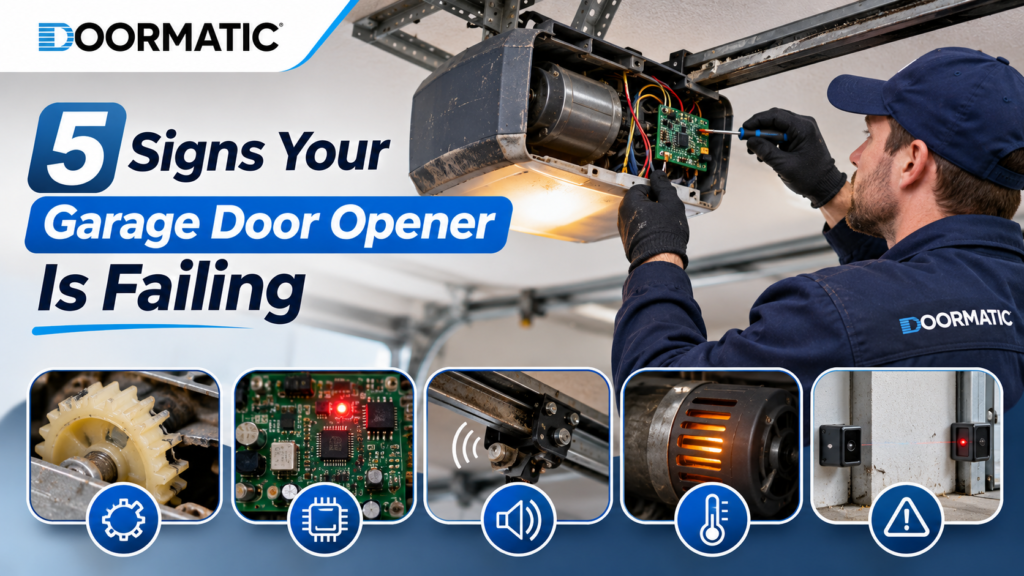
What Are the Most Common Signs Your Garage Door Opener Is Failing?
Five signs point to a garage door opener that needs replacing, not patching.
Stripped internal gears. The motor hums but the door doesn’t move. The internal plastic drive gear has shredded. On openers over 10 to 15 years old, replacing the gear is rarely worth the cost — the rest of the unit is equally worn.
Intermittent logic board failure. The door opens or closes on its own, stops responding to the wall switch and remote simultaneously, or loses its travel limits. Power surges and hard freeze events in the GTA accelerate circuit board degradation on aging units.
Grinding and vibration. Metal-on-metal grinding or heavy shaking on the ceiling mount signals worn motor bearings or a failing trolley assembly — a mechanical failure, not a maintenance issue.
Motor overheating. The opener stops mid-cycle and won’t move for 15 to 20 minutes while it cools. The motor’s thermal protection is tripping from internal wear — a healthy motor doesn’t overheat under normal use.
Age over 15 years. Older openers pre-dating current Canadian safety requirements may lack mandatory photoelectric sensors, and replacement parts for many of these units are discontinued.
Why Do Garage Door Openers Fail Faster in the GTA?
GTA freeze-thaw cycles affect door balance. When seasonal shifts cause tracks to shift or springs to lose tension, the motor compensates by working harder, accelerating internal wear. High cycle counts combined with temperature extremes can shorten opener life regardless of drive type.
When Should You Repair vs. Replace Your Garage Door Opener?
Repair makes sense when the opener is under 10 years old and the fault is isolated — a trolley roller, a remote reprogramming, or a sensor realignment. If the unit responds consistently and lifts smoothly, targeted repair is reasonable.
Replace when the unit is 10 to 15 years old and showing more than one failure sign. Repair costs at that stage extend the life of a system nearing its end, while a new opener adds battery backup, Wi-Fi, and safety features the old unit can’t match.
What Type of Garage Door Opener Should You Choose as a Replacement?
For most GTA homes with an attached garage or a bedroom above the garage, a DC-motor belt drive opener is the right choice.
Belt drive systems are quieter than chain drive — no metal-on-metal contact at startup or through the cycle. DC motors add soft-start and soft-stop, reducing mechanical stress on the door and hardware with each use.
Chain drive openers cost slightly less and work well for detached garages. See belt drive vs. chain drive garage door openers for a full comparison.
| Drive Type | Noise | Best For |
|---|---|---|
| Belt drive | Quiet | Attached garages, bedrooms above |
| Chain drive | Louder | Detached garages |
| Direct drive | Very quiet | Low-headroom garages |
| Wall-mount | Very quiet | Finished ceilings, low-headroom |
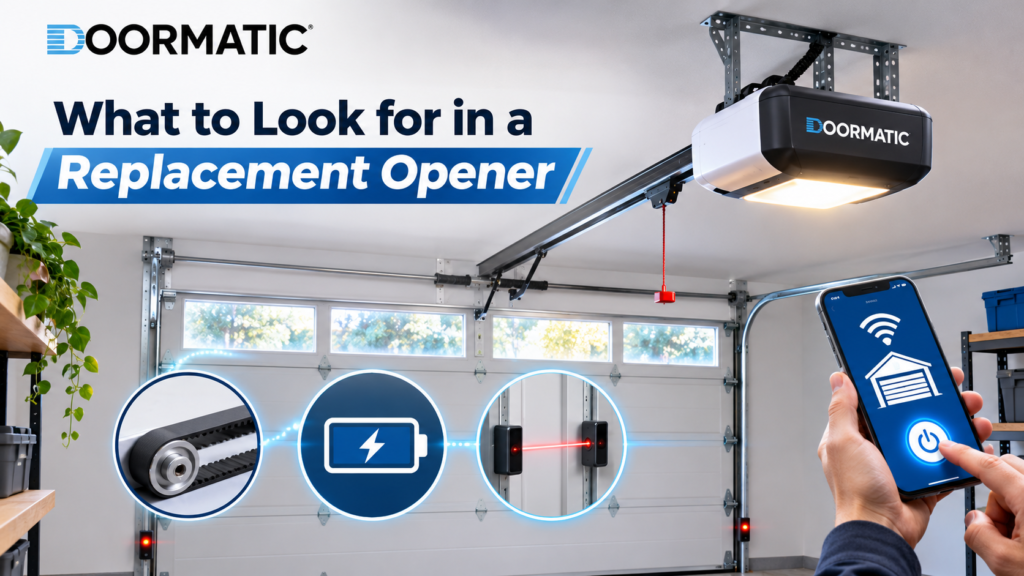
What Features Should a Replacement Garage Door Opener Have?
Battery backup keeps the door operational during power outages — a necessity in Ontario winters when storms knock out power.
Wi-Fi connectivity lets you open, close, and monitor the door from a smartphone app, with integration into home automation platforms.
Rolling code technology changes the access code after every use, making signal interception significantly harder than older fixed-code remotes. Any replacement opener should include this as standard.
Adequate motor power matters for door size and weight. Most single residential doors work with a ½ HP unit; double doors or heavier insulated doors benefit from ¾ HP.
Key Takeaways
- Belt drive openers typically last 15 to 20 years; chain drive 10 to 15; replace when multiple failure signs appear
- Stripped gears, logic board faults, motor overheating, and missing safety sensors all indicate replacement
- GTA freeze-thaw cycles and high cycle counts shorten opener life faster than moderate climates
- A DC-motor belt drive with Wi-Fi and battery backup suits most attached GTA garages
- Rolling code technology is a standard security feature any replacement opener should include
Frequently Asked Questions
How long does a garage door opener last?
Belt drive openers typically last 15 to 20 years; chain drive units average 10 to 15. In the GTA, frequent cycling and temperature extremes can shorten that range. If yours is showing failure signs, price a replacement before it fails completely.
What is rolling code technology and why does it matter?
Rolling code technology changes the radio code the remote sends after each use. Older fixed-code systems send the same signal every time, making them easier to intercept. Any modern replacement garage door opener should use rolling code as standard.
Is a belt drive garage door opener worth the extra cost?
For homes with an attached garage or a bedroom above it, yes. Belt drive systems are quieter than chain drive, and DC motors with soft-start and soft-stop operation reduce wear over time. The noise difference is noticeable from the first cycle.
Do I need battery backup on my garage door opener?
Battery backup is worth having in Ontario, where winter storms cut power for hours. Without it, the door can’t be operated during an outage without disengaging the opener manually. Many replacement openers include battery backup — confirm availability on the unit you’re considering.
Can I replace just the remote instead of the whole garage door opener?
Yes, if the opener is functioning correctly. For modern openers, buy a compatible or universal remote. For older fixed-code units, a universal remote works but won’t add rolling code security. If the opener is over 10 years old and the remote is the first thing to fail, check the full system before assuming it’s the only issue.
Book a Garage Door Opener Replacement With Doormatic
Doormatic installs garage door openers across Woodbridge, Vaughan, Toronto, North York, and the GTA.
Call 416-722-6595, email info@doormatic.ca, or request a free estimate online. Based at 180 Trowers Rd, Unit 23, Woodbridge, ON L4L 8A6.
Related reading: Belt drive vs. chain drive garage door opener · Garage door opener installation cost in Ontario