By the Doormatic Editorial Team | Updated November 2026
When patio door glass fogs, cracks, or stops sealing properly, the real question is whether the door itself is worth keeping. If the hardware is worn, a full patio door replacement gives you better performance and a longer service life than chasing individual failures on an aging door. This guide helps GTA homeowners make that call — and choose the right door when it’s time for a full replacement.
When Is It Time to Replace Your Patio Door Entirely?
A full patio door replacement makes sense when the glass failure is part of a larger pattern of wear, not an isolated problem. If the frame is warped, tracks are corroded, or the door is hard to slide and lock securely, replacing only the glass extends the life of a failing system.
In the GTA, temperature swings from humid 30°C summers to –20°C winters stress sliding patio doors hard. Freeze-thaw cycles work moisture into frame joints, tracks shift, and rollers wear. When a glass unit fails in an older door, assessing the full system before committing to a repair is the right approach.
Consider a full door replacement when:
- The frame is warped or the door no longer sits square in the opening
- Tracks are visibly corroded or the door drags, binds, or skips
- Rollers are worn and the door is difficult to slide
- The door fails to lock or latch securely
- The door is over 15 to 20 years old and showing multiple issues
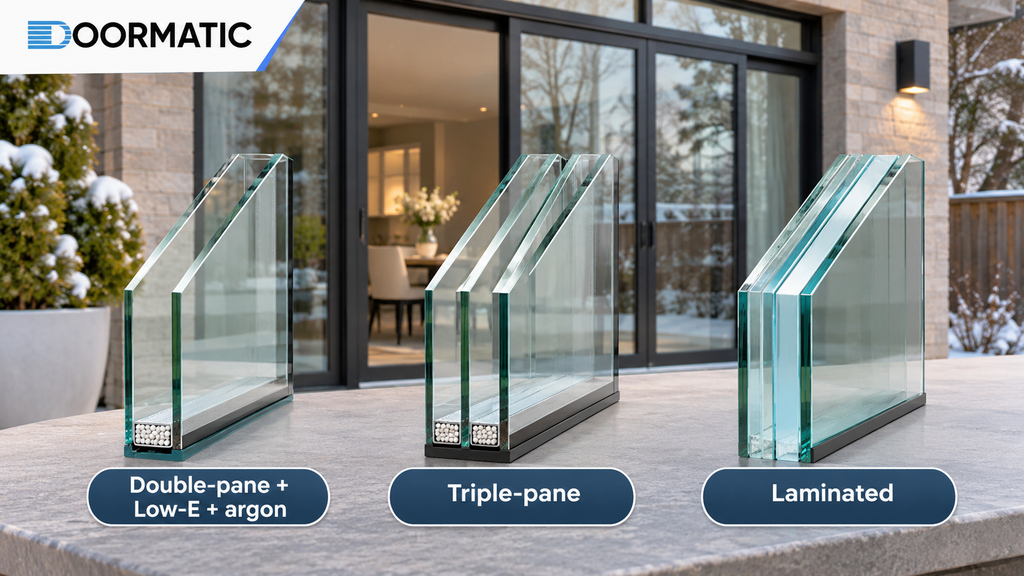
What Type of Glass Should You Look for in a Replacement Patio Door?
Ontario Building Code requires all patio door glass to be safety glazing — tempered or laminated — because of the large surface area and the risk of human impact. Beyond that baseline, the right glass configuration depends on your property’s exposure, security needs, and energy priorities.
Double-pane tempered glass with Low-E coating and argon gas is the standard for most GTA residential patio doors. Low-E coatings reflect infrared heat back toward its source, reducing heat loss in winter and blocking excess solar heat in summer. Argon gas between the panes slows thermal transfer.
Triple-pane glass adds a third sealed layer and performs better on cold-facing exposures — a north or east-facing patio benefits from the extra insulation and noise reduction triple-pane provides.
Laminated glass is bonded with a plastic interlayer that holds together when cracked, providing break-in deterrence and noise reduction. It is standard for commercial properties, ground-floor units, and security-sensitive properties.
| Glass Type | Energy Efficiency | Best For |
|---|---|---|
| Tempered double-pane + Low-E + argon | Good | Most GTA residential patio doors |
| Triple-pane | Best | Cold-facing exposures |
| Laminated | Good | Security, noise reduction, commercial |
What Causes Patio Door Glass to Fail in the GTA?
The most common failure is a broken seal on a double-pane unit. When the seal fails, moisture enters the cavity between the panes and causes fogging. Fogged glass reduces visibility and eliminates the insulating value of the argon fill — the door becomes a cold spot in winter.
GTA freeze-thaw cycles accelerate seal degradation. Condensation forms on the cold glass surface, works into micro-gaps around the frame edge, freezes, and slowly separates the seal. Once the seal breaks, the insulating gas escapes — the IGU needs replacing to restore performance.
What Energy Efficiency Specifications Matter for a GTA Patio Door?
For a GTA patio door, three specifications matter:
U-factor measures how well the door resists heat loss. Lower is better. ENERGY STAR Canada v5.0 sets a U-factor of 1.22 W/m²K for sliding glass doors — confirm any replacement meets or beats this threshold.
Low-E coating is a microscopically thin metallic layer that reflects radiant heat without noticeably reducing visible light. It reduces heat transfer through the glass in both directions.
Argon or krypton gas fill slows heat transfer through the insulated cavity between panes. Argon is standard in double-pane units; krypton is used in higher-performance triple-pane configurations.
Key Takeaways
- Replace the full door when the frame, tracks, or rollers are worn — a glass swap in a failing door is a short-term fix
- Ontario Building Code requires tempered or laminated safety glass in all patio doors
- Double-pane tempered with Low-E and argon is the right baseline for most GTA residential patio doors
- ENERGY STAR Canada v5.0 sets a U-factor of 1.22 W/m²K for sliding glass doors
- Triple-pane suits cold-facing exposures; laminated suits security-sensitive and commercial properties
Frequently Asked Questions
When does patio door glass replacement make more sense than a full new door?
A glass-only swap makes sense only when the frame, tracks, and rollers are structurally sound. If the door drags, the frame is warped, or it fails to latch properly, those are signs the full unit needs replacing.
What glass is required by code for a patio door in Ontario?
The Ontario Building Code requires safety glazing — tempered or laminated glass — in all patio doors due to the large panel area and impact risk. Tempered glass shatters into small, dull-edged pieces. Laminated glass holds together when broken, offering added security.
Can patio door glass be replaced without replacing the frame?
In some cases, yes — if the frame, tracks, and hardware are in good condition, an insulated glass unit (IGU) can be installed without removing the door frame. In the GTA, frames old enough to have a failed glass seal are often showing wear themselves. A full assessment before committing to glass-only work is worth the time.
What energy efficiency standard applies to patio doors in Canada?
Canada uses a single national standard, not regional climate zones. ENERGY STAR Canada v5.0 sets a U-factor of 1.22 W/m²K for sliding glass doors. Lower values indicate better thermal insulation. Confirm any replacement door meets or beats this threshold.
Does laminated glass improve security for a patio door?
Yes. Laminated glass has a plastic interlayer that holds the panel together even when cracked, making forced entry significantly harder than standard tempered glass. It also reduces noise — practical for ground-floor doors and commercial properties.
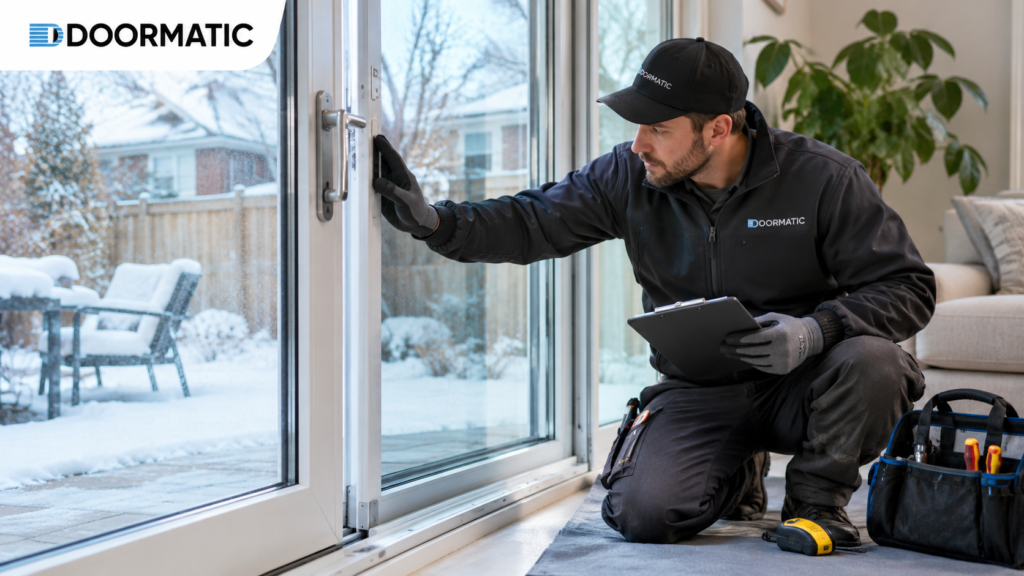
Book Your Patio Door Replacement With Doormatic
Doormatic supplies and installs patio doors across Woodbridge, Vaughan, Toronto, North York and the GTA.
Browse Doormatic’s patio door options, call 416-722-6595, email info@doormatic.ca, or request a free estimate online. Based at 180 Trowers Rd, Unit 23, Woodbridge, ON L4L 8A6.
Related reading: How to measure a sliding glass door for replacement · Energy-efficient windows in Ontario