By Doormatic Technical Staff | Certified Door & Window Specialists, Woodbridge, ON
For Ontario winters, fibreglass is the strongest all-round choice — it resists warping, doesn’t rust, and matches wood’s appearance without the maintenance demands. Steel wins on security and price. Wood wins on beauty but loses on upkeep in freeze-thaw climates. Doormatic handles front door installation across Woodbridge and the GTA.
Key Takeaways
- Fibreglass front doors resist warping, cracking, and moisture — the best all-round choice for Ontario’s freeze-thaw climate
- Steel doors provide superior security compared to wood or fibreglass and can last over 30 years with proper maintenance
- Wood doors require refinishing every 1–3 years in Ontario’s climate — more frequently on south and west exposures
- ENERGY STAR-certified steel doors with polyurethane foam cores achieve manufacturer-rated R-values of 10–17 — installed performance depends on frame condition and air sealing
- Entry door replacement in Ontario typically costs C$1,300–C$4,000+ depending on material, glass, and installation complexity
The Short Answer
Fibreglass is the right call for most Ontario homeowners — it handles freeze-thaw cycles, requires minimal maintenance, and can convincingly replicate wood grain without the upkeep cycle.
The one condition that flips it: if maximum security is the top priority, a solid-core steel door with reinforced locking mechanisms and a polyurethane foam core outperforms fibreglass on forced-entry resistance.
For natural wood beauty with a commitment to regular refinishing, the material longevity differences are significant across Ontario’s climate — see the section on wood doors below.
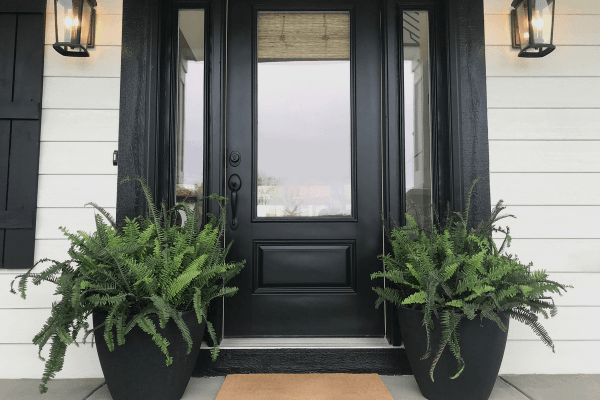
Side-by-Side Comparison
Comparison Table
| Attribute | Steel | Fibreglass | Wood |
|---|---|---|---|
| R-value | R-10 to R-17 (manufacturer-rated; installed performance varies) | R-5 to R-7 | R-2 to R-3 |
| Freeze-thaw performance | Excellent | Excellent | Poor without maintenance |
| Security | Excellent | Very good | Good |
| Maintenance | Low | Very low | High |
| Rust risk | Yes (at scratches) | No | No |
| Warping / cracking | No | No | Yes |
| Typical lifespan | 30+ years | 20–30 years | 10–20 years |
| Typical cost installed | C$1,300–$2,500 | C$1,500–$3,500 | C$2,000–$4,000+ |
Cost
Steel front doors are the most affordable option — typically C$1,300–C$2,500 installed for a standard residential entry door in Ontario. Fibreglass doors run C$1,500–C$3,500 depending on grain texture, glass inserts, and hardware. Wood doors in premium species such as mahogany, white oak, or Douglas fir can push past C$4,000 installed, particularly for custom sizing or non-standard openings. Factor in the ongoing cost of maintenance coats when a wood door needs to be replaced or refinished every few years — the total cost of ownership over 20 years often exceeds that of a fibreglass alternative.
Steel in Detail
Steel doors typically use steel skins around a rigid insulated core — most commonly high-density polyurethane foam — for substantial rigidity and thermal efficiency. Insulated cores in steel doors help retain indoor heat during winter and block outdoor heat in summer. Steel doors can weigh between 100 and 200 pounds, require a minimum 4-inch frame depth, and should be installed with a minimum of three hinges for proper load distribution. A well-sealed steel door with proper weatherstripping improves comfort and heating and cooling efficiency significantly. ENERGY STAR-certified steel doors help with insulation and cost savings over time.
The Caveat Most People Miss
Steel doors resist warping and cracking but are vulnerable to rust at scratches and exposed edges — a compromised finish in Ontario’s salt-heavy winters accelerates corrosion and must be addressed promptly.
Fibreglass in Detail
Fibreglass front doors are engineered to resist warping, cracking, and denting in Ontario’s freeze-thaw climate. They do not conduct heat the way steel does and are available in smooth contemporary finishes or wood-grain textures that replicate the natural beauty of real wood species. The dimensional stability of fibreglass — its resistance to expansion and contraction across temperature swings — makes it a stronger performer than other materials in Canadian climates. Quality fibreglass doors achieve R-5 to R-7 — lower than insulated steel but significantly better than wood. They hold paint and stain finishes without the annual refinishing cycle that wood demands, and the UV-resistant finish provides long-term protection against colour fade on south-facing exposures. For a comparison of fibreglass and steel on garage and entry door performance, see steel vs fibreglass garage door — which is better.
Time and Effort
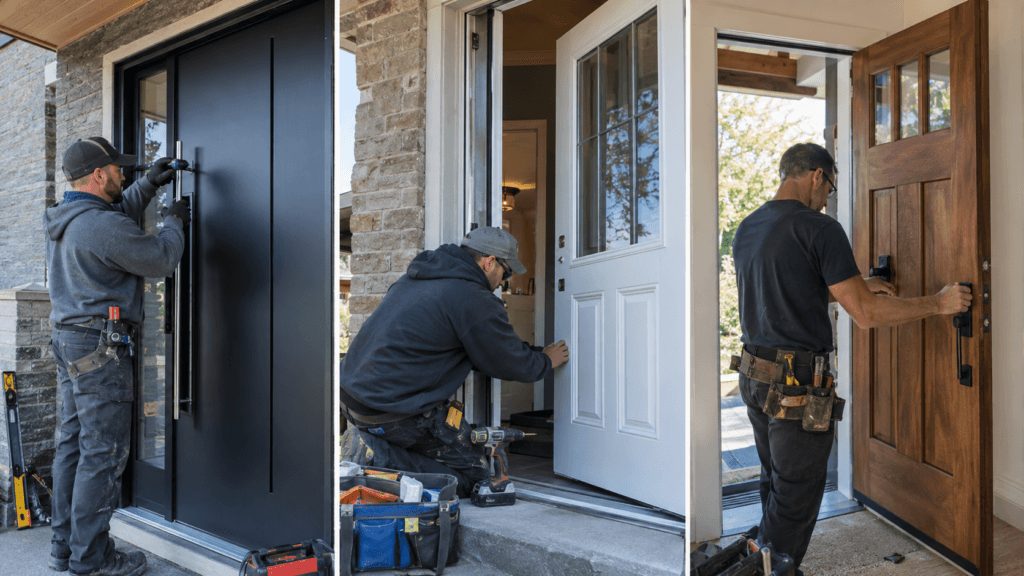
Steel and fibreglass front doors require similar installation time — typically 3–5 hours for a standard residential entry door replacement in an existing frame, assuming the frame is square and in good condition. Installation requires a level and plumb frame; a minimum of three hinges on steel doors; and proper weatherstripping fitted at all four sides. Wood door installation takes comparable time but the frame must be assessed for moisture damage before the new door is fitted. Ongoing maintenance effort differs significantly: wood doors need sanding, staining or painting, and sealing every 1–3 years, while fibreglass needs occasional cleaning and steel needs finish touch-up if scratched.
Outcome and Risk
Steel provides superior security and the highest R-value of the three materials when fitted with a polyurethane foam core. The primary risk is rust at compromised finish areas. Fibreglass delivers the best balance of thermal performance, aesthetics, and low maintenance. The primary risk is colour fade over time on south-facing exposures without UV-stable finish. Wood delivers the most natural beauty but carries the highest long-term risk in Ontario’s climate — moisture absorption, warping, and rot without consistent maintenance. A poorly maintained wood door in Ontario’s freeze-thaw cycle can fail structurally within 10 years.
When Steel Is the Right Call
Security Is the Top Priority
Steel resists forced entry better than wood or fibreglass. Steel doors are built with reinforced locking mechanisms and solid steel skins around a polyurethane core, making them the material of choice for homes with elevated security and safety concerns. Many steel doors feature integrated hardware support for reinforced locking systems. Steel provides superior security compared to wood doors — and most steel doors offer excellent fire-resistance ratings as well.
Budget Is the Primary Constraint
Steel front doors are the most cost-effective entry door option in Ontario. A quality ENERGY STAR-certified steel door installed by a professional delivers strong thermal performance, a 30+ year lifespan with proper maintenance, and a significant security upgrade over an old wood door — at the lowest installed price of the three materials.
The Application Is Commercial-Adjacent
Steel doors are often used in commercial applications where durability, fire ratings, and security standards exceed residential requirements. For residential properties that share a wall with a garage, utility room, or commercial tenancy, a steel entry door with a fire-resistance rating is frequently the code-compliant and practical choice. For exterior door considerations across commercial and garage-adjacent spaces, see the best front doors for Woodbridge homes.
When Fibreglass Is the Right Call
High-Moisture or High-Exposure Location
Fibreglass does not absorb moisture, does not rust, and does not warp under Ontario’s freeze-thaw cycling. North-facing doors, lakefront properties, and homes on heavily salted winter roads all benefit from fibreglass over steel. The manufacturing process for quality fibreglass doors produces a final product that is dimensionally stable across a wide temperature range.
Wood Aesthetic Without the Maintenance Cycle
Wood-grain fibreglass front doors replicate the appearance of real wood species — mahogany, oak, and fir textures are commonly available — with a fraction of the maintenance demand. Ontario’s climate makes real wood front doors a significant ongoing commitment. Fibreglass delivers the visual warmth of natural wood without requiring refinishing every 1–3 years. For homeowners who have previously maintained a wood door and want guidance on restaining, see how to restain a front wood door before deciding whether to continue or switch materials.
Long-Term Energy Performance Is a Priority
Fibreglass doors do not conduct heat through the door slab the way steel does — there is no thermal bridging through the shell. Combined with a quality foam core and proper weatherstripping, a fibreglass entry door delivers consistent long-term energy efficiency without the thermal bridging risk present in steel door construction.
What Most People Get Wrong
R-Value Is Not the Full Story
Many Ontario homeowners focus on the door’s R-value and overlook air leakage at the frame — which typically accounts for more heat loss than the door slab itself. A steel door with R-17 installed poorly in a warped or unsealed frame will underperform a fibreglass door with R-6 installed correctly in a sound frame with properly fitted weatherstripping.
Steel Is Not Maintenance-Free
The second misconception is treating steel as inherently low-maintenance. Steel doors are resistant to warping and cracking — but they are not maintenance-free. A scratch that reaches the bare steel surface will rust in Ontario’s winters, particularly in areas with heavy road salt. The rust begins at the scratch, migrates under the finish, and if left unaddressed causes paint lifting and deeper corrosion. Touch-up paint and annual inspection of the finish are standard steel door maintenance tasks that many homeowners skip.
ENERGY STAR Certification Applies to the Full Assembly
ENERGY STAR certification on an entry door means the complete door-and-frame assembly — including weatherstripping and threshold — meets the thermal standard. A door that is ENERGY STAR certified in the manufacturer’s catalogue does not automatically meet that standard after installation. The installation method matters as much as the product specification. Proper installation enhances security and energy efficiency for steel doors and fibreglass doors equally.
What We Recommend for Woodbridge Homeowners
Our First-Party Position
Doormatic’s recommendation for most Woodbridge and GTA homeowners: fibreglass in a wood-grain finish with an insulated core, quality weatherstripping on all four sides, and a multi-point locking system. This combination delivers Ontario-appropriate thermal performance, excellent security, no rust risk, and a natural wood aesthetic that can complement any modern or traditional home exterior — without the refinishing commitment that real wood demands in Canada’s freeze-thaw climates.
For homes where maximum security or a tight budget drives the decision, a solid-core steel door with ENERGY STAR certification, a polyurethane foam core, and reinforced hardware is the correct specification. Many steel doors are thermally broken and insulated to reduce heat exchange — confirm this feature before committing to a specific model.
For front door installation in Woodbridge and across the GTA, Doormatic provides written quotes specifying material, R-value, and hardware before any work begins. We customize the specification to your home’s exposure, style, and budget — and every quote is in writing before work begins. Energy-efficient front doors create a better first impression, reduce heating costs over the life of the door, and can increase a home’s resale value.
Frequently Asked Questions
Which front door material is best for Ontario winters?
Fibreglass is best for most Ontario homes — it resists warping and moisture through freeze-thaw cycles and is available in wood-grain finishes. Steel is stronger where security is the top priority. Wood demands regular refinishing to survive Ontario winters. Doormatic installs all three materials across Woodbridge and the GTA.
Are steel entry doors good for cold climates?
Yes. Steel doors with polyurethane foam cores and ENERGY STAR certification perform well in Ontario — achieving manufacturer-rated R-values of 10–17, with installed performance depending on frame condition and weatherstripping quality. The primary vulnerability is rust at scratched finish areas in Ontario’s salt-heavy winters. Thermally broken steel doors further reduce heat transfer through the door frame.
How long do fibreglass exterior doors last in Ontario?
Quality fibreglass exterior doors last 20–30 years in Ontario with minimal maintenance. They do not warp, crack, or rust through freeze-thaw cycles. Compared to wood doors, which may need replacement in 10–15 years without consistent refinishing, fibreglass offers significantly better long-term value.
What is the most energy efficient new door for an Ontario home?
An insulated steel or fibreglass entry door with ENERGY STAR certification, a polyurethane foam core, Low-E glass inserts, and proper weatherstripping. Steel doors achieve manufacturer-rated R-values of 10–17 — the highest of the three materials — but installed performance depends on frame condition and air sealing. Fibreglass reduces thermal bridging through the slab. Both outperform wood on energy efficiency in Ontario’s climate.
About Doormatic
Doormatic is a Woodbridge-based door and window company providing front door installation for residential and commercial properties across the Greater Toronto Area. Our certified installers specify material, R-value, and hardware on every front door quote — steel, fibreglass, and wood options available across the full range of entry door styles. Written quotes provided before any work begins, no hidden charges.
Service Area
Doormatic serves Woodbridge, Vaughan, North York, Toronto, Mississauga, Brampton, Richmond Hill, Aurora, and King City. NAP: 180 Trowers Rd Unit 23, Woodbridge, ON L4L 8A6 · 416-722-6595 · info@doormatic.ca.
Next Step
Book a free front door assessment or request a written quote online. Front door installation — Woodbridge and the Greater Toronto Area.