Yes, you can replace a window, front door, or garage door in a GTA winter — but the risk level is not equal across all three. Below freezing, materials behave differently, sealants cure slowly, and an installation that looks complete on the day can fail silently over the following weeks. This post explains the challenges cold weather introduces, ranks all three products from most to least forgiving, and tells you what to expect if your replacement is scheduled between November and March. It’s for GTA homeowners who can’t wait until spring.
Key Takeaways
- Below freezing, adhesives, expanding foam, and sealants all perform below their rated specifications — increasing the risk of drafts, water infiltration, and thermal failure.
- Windows are the most forgiving winter replacement in the GTA; garage doors are the most unforgiving; front doors fall in the high-stakes middle.
- The footprint of the opening determines the risk: a larger opening means more cold air entering the home, more surface area to seal, and more margin for error.
- Professional installation is essential in winter — the tolerance for misalignment, missed sealing, or under-cured foam is lower when temperatures are at or below zero.
- Fibreglass and steel doors are the right materials for cold-weather replacements; wood is not.
- Energy efficiency gains from a properly installed winter replacement are real — a well-sealed, insulated door or window performs better than the failing unit it replaced regardless of when it went in.
Why Below-Freezing Installations Are Different
Toronto’s winters are not uniformly cold. The GTA runs through repeated freeze-thaw cycles — a week at –10°C followed by a mild stretch, then back below freezing — which is harder on installation materials than a sustained deep freeze. That thermal cycling exposes workmanship gaps that might hold in a more stable climate.
When temperatures drop to and below zero, the chemistry of an exterior installation changes. Polyurethane expanding foam — used to insulate the gap between a frame and the rough opening — cures more slowly and may not fully expand in extreme cold. Silicone sealant applied to a frozen substrate bonds poorly and can delaminate during the first warming cycle. Weather stripping adhesive that sets correctly at 15°C can remain weak at –5°C, failing to form the compression seal it needs.
The result is not always visible immediately. A front door installed on a cold day may appear level, square, and tight. By February, after freeze-thaw cycles have worked on under-cured foam and poorly bonded sealant, the homeowner notices drafts at the threshold or condensation at the frame edges. That is a failed installation — avoidable with the right practices and, in extreme cold, the right scheduling.
Windows: The Most Forgiving Winter Replacement
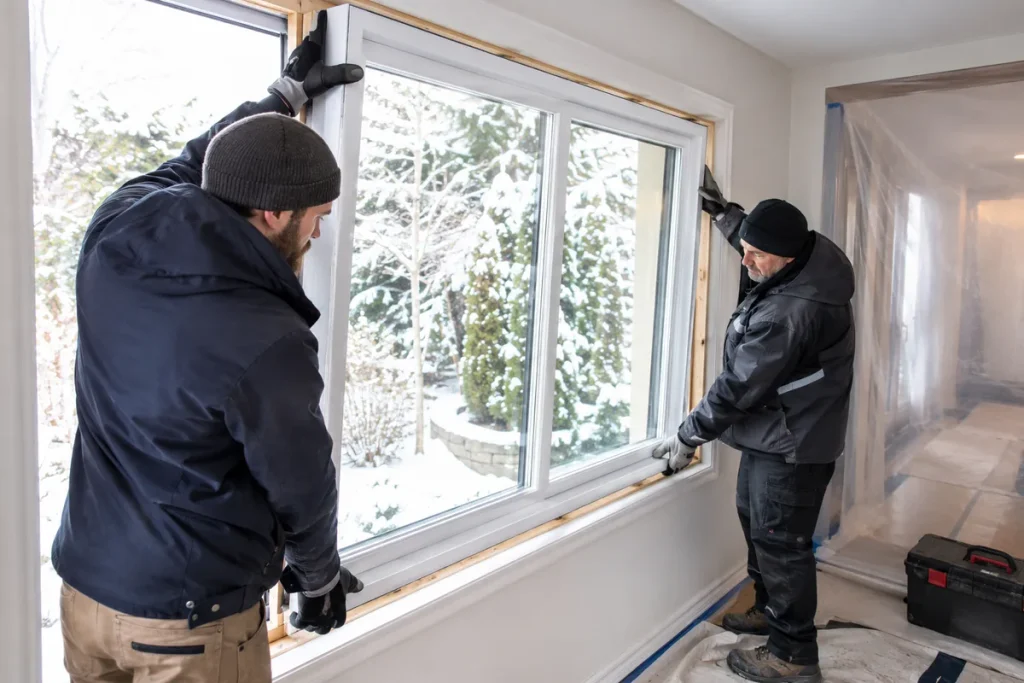
Of the three products, windows are the most practical to replace in GTA winter conditions. The opening is comparatively small, the exposure time during installation is short, and modern window units arrive as complete factory-assembled assemblies that are set into the rough opening and sealed — reducing the number of field variables.
A window replacement keeps most of the wall intact. The old unit comes out, the rough opening is inspected, the new unit goes in, foam fills the perimeter gap, and sealant closes the exterior. The total time the opening is exposed to outside air is measured in minutes for a skilled installer. Indoor temperature drops are modest and recover quickly.
Cold still affects window installations. The foam and sealant rules apply — a frozen substrate needs surface prep before sealant is applied. Low-E glass with argon fill performs well from day one after installation, which is an advantage: the homeowner notices the improvement immediately, even in winter.
Front Doors: High Stakes in the Middle
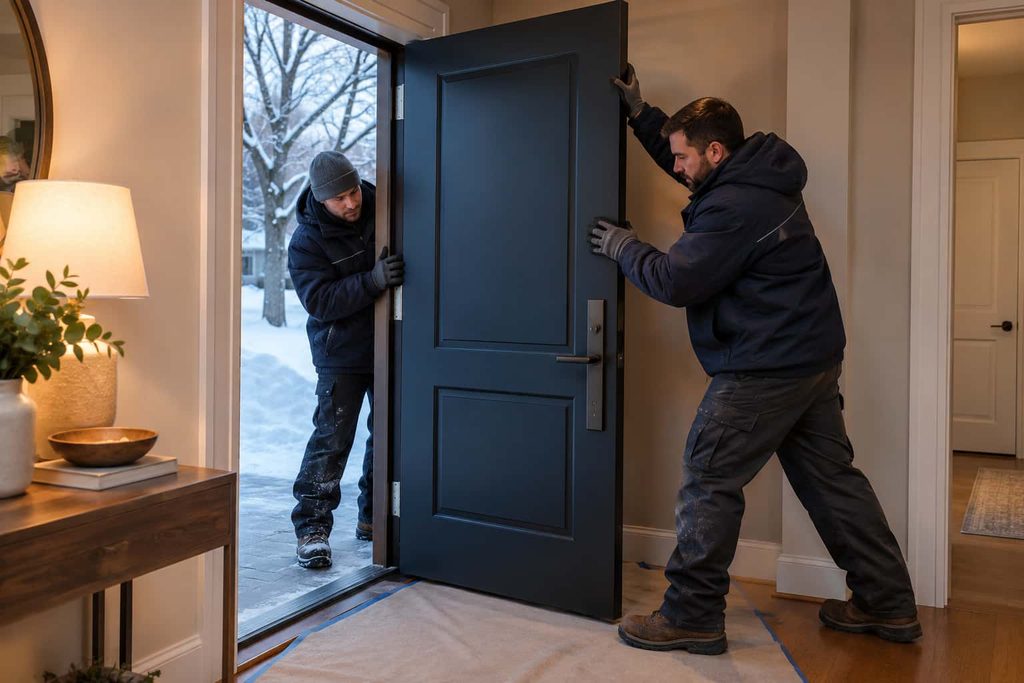
A front door replacement sits in the middle of the risk range — more exposed than a window, less technically complex than a garage door, but demanding enough that a cold-weather install done without care causes lasting problems.
The opening is significantly larger than a window rough opening. During installation, the entire front entry is open to outside air for the duration of the job — longer than a window and long enough for interior temperatures to drop meaningfully, particularly in an unheated or lightly heated foyer. The pre-hung unit must be set level and plumb in conditions where frost on the sill plate or in the rough framing can cause the frame to shift slightly as it warms.
Weatherstripping on a front door is load-bearing in a thermal sense — it is the primary seal between the conditioned interior and the exterior. In winter, compression weatherstripping must be seated correctly on the day of installation, because cold temperatures slow the material’s ability to conform to the frame profile. If it’s under-compressed because the threshold wasn’t properly set, it will fail to seal.
For GTA homeowners, the material choice for front doors matters more in winter than in spring. Fibreglass entry doors resist the freeze-thaw cycle that damages wood — they won’t swell, warp, or crack as temperatures swing. Steel entry doors provide reinforced construction and hold their shape in cold conditions. Wood is the wrong material choice for a winter installation in an exposed Woodbridge or Toronto doorway: it absorbs moisture during the installation window and can swell before it’s fully hung and sealed.
Front doors with sidelights, transoms, or glass panels introduce additional sealing requirements. Low-E glass in sidelights reduces heat loss through the glazed area; the frame and sealant around those panels need the same care as the door perimeter. Multi-point locking systems should be tested through several full open-close cycles on the day of installation to confirm alignment in cold conditions.
For entry doors in Woodbridge and Vaughan, see the front doors Woodbridge page, or read how to choose the right garage door for your home for a full material comparison.
Garage Doors: The Most Unforgiving Winter Replacement
A garage door replacement in winter is the most technically demanding of the three jobs — not because the door itself is more complex to source, but because the opening footprint is the largest, the hardware installation is the most sensitive to cold, and the consequences of a rushed job show up fast.
A single-car garage door opening runs 8 to 9 feet wide and 7 to 8 feet tall. A double-car opening runs 16 feet wide. During the removal and installation window, the garage is fully open to outside air. If the garage is attached to the house, interior temperatures in adjacent rooms can drop significantly.
Springs are the most temperature-sensitive component of a garage door system, and cold weather affects how they function. A winter installation requires an experienced team that understands how to set spring tension correctly in cold conditions and test the full balance of the door before completing the job.
Insulated garage doors — multi-layer steel with a polyurethane foam core — are the right choice for any GTA garage, particularly when installation happens in winter. An insulated door maintains a more stable garage temperature and performs better year-round for an attached garage where energy efficiency in the adjacent living space matters.
What This Means for GTA Homeowners Scheduling a Winter Replacement
If your window, front door, or garage door has failed — drafts you can feel, water getting in, a door that won’t close — waiting until spring is not always viable. Cold-weather replacements are done every winter in the GTA. The difference between a successful one and a failure is the installer’s approach, not the season.
For windows, proceed — exposure time is short and the job is well-suited to cold weather. For front doors, material choice and installation quality matter more in winter than in mild conditions; fibreglass or steel, professionally installed, will perform correctly. For garage doors, use an installer with winter experience, confirm that springs will be tension-adjusted for seasonal variation, and plan the job for a milder day where possible.
Frequently Asked Questions
Can a front door be replaced in a GTA winter?
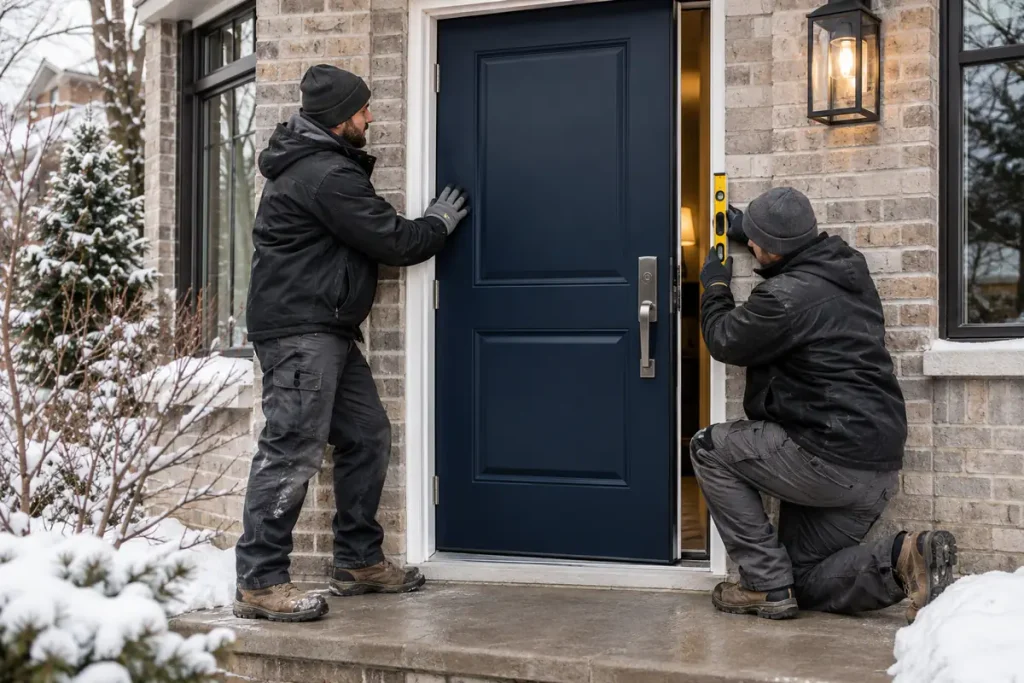
Yes. Front door replacement is done in the GTA throughout the year, including winter months. Fibreglass and steel entry doors are the right choices for a cold-weather install — both resist the freeze-thaw cycle and hold their dimensions in cold conditions. The critical variables are installer experience with cold-weather sealant and weatherstripping practices, and the material temperature of the substrate before sealing.
What exterior doors work best in cold weather for energy efficiency?
Insulated fibreglass and insulated steel are the two materials that perform best in GTA winters. A fibreglass door with a high-density polyurethane foam core resists heat transfer effectively and doesn’t warp or crack under freeze-thaw cycling. Steel doors with thermal breaks also perform well. Both qualify for ENERGY STAR certification when they meet the rated performance thresholds. Low-E glass in any sidelights or door inserts reduces heat loss through the glazed area.
Is garage door installation harder in winter?
Yes, more so than window or front door replacements. The large opening creates significant cold air exposure during installation, and spring tensioning in cold conditions requires experienced hands. Use an installer with winter garage door experience rather than a team that treats it as a standard warm-weather job.
Does a new garage door improve a home’s first impression in winter?
Yes, more so than window replacements or installations of front doors. The large opening creates significant cold air exposure during installation, and spring tensioning in cold conditions requires experienced hands. Use an installer with winter garage door experience rather than a team that treats it as a standard warm-weather job.
Are high-end entry doors worth installing in winter?
A high-end front door — fibreglass with a wood-grain finish, full glass panel, or a custom double-door entry — can be installed in GTA winter conditions with the right professional. The sealant and foam work requires more care in cold temperatures, but the result is the same well-performing door you would have in any season. If the existing front doors are failing, waiting until spring means months of heat loss and security risk.
Book a Winter Door or Garage Door Replacement With Doormatic
Doormatic installs exterior doors and garage doors across Woodbridge, Vaughan, Toronto, and the Greater Toronto Area.
For a free quote on a winter door installation, call 416-722-6595, email info@doormatic.ca, or request a free estimate online. Based at 180 Trowers Rd, Unit 23, Woodbridge, ON L4L 8A6.