If water is getting under your garage door during rain or snowmelt, the bottom seal is usually where the problem starts — but on a reverse-slope driveway in North York, the seal alone is rarely the whole story. This post explains why reverse-slope driveways in North York’s older neighbourhoods create a persistent water problem, why standard builder-grade seals fail under those conditions, and what actually works. It’s for North York homeowners dealing with garage flooding and looking for a solution that holds.
Key Takeaways
- North York’s post-war below-grade garages and clay-heavy soils make reverse-slope driveways unusually prone to water infiltration.
- Freeze-thaw cycles shift driveway bases and buckle asphalt, creating pathways for water that didn’t exist when the garage was built.
- Standard builder-grade vinyl bottom seals fail under hydrostatic pressure — any dip in the concrete floor lets water bypass the barrier.
- Heavy-duty rubber bottom seals with enough flexibility to conform to an uneven floor are the right solution for this application.
- A floor-mounted threshold bar provides a secondary barrier when the bottom seal alone can’t compensate for grade or floor irregularity.
- Inspect seals at least once a year — especially after winter — and replace them before the gap becomes large enough to let water past.
Why Reverse-Slope Driveways in North York Create a Water Problem
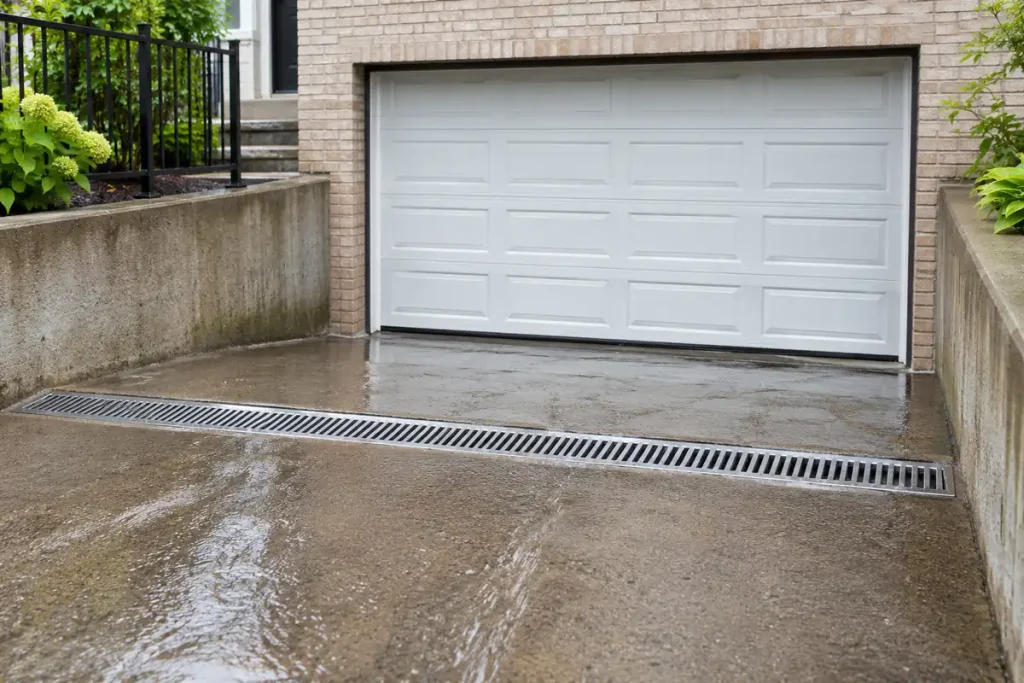
Many homes in North York neighbourhoods like Willowdale and Newtonbrook were built during the post-war period, when below-grade garages were a standard design for lots with sloped frontages. The driveway descends toward the garage rather than away from it. In a dry year with functioning drainage, that works. The problem compounds over decades.
North York sits on clay-heavy soils that limit natural water infiltration. When rain or snowmelt hits a clay-dominant lot, the water doesn’t drain into the ground — it runs toward the lowest point, which on a reverse-slope driveway is the garage door. The city’s aging municipal infrastructure in these neighbourhoods adds to the pressure: drains that handled the original drainage load from smaller impervious surfaces are now managing more water from expanded driveways and neighbouring development. This makes proper garage door installation and drainage planning especially important for homeowners in North York.
The freeze-thaw cycle does the rest. Water works into asphalt cracks, freezes, expands, and shifts the driveway base. Over years, that movement creates low spots that pool water and buckles the surface in ways that direct flow toward the garage door. A driveway that drained acceptably when the house was built may now funnel water directly at the garage door.
Why Standard Bottom Seals Fail Here
The bottom seal on a residential garage door sits between the door panel and the garage floor. Its job is to compress against the floor when the door closes and block the gap. On a flat, level floor with a mild driveway grade, a standard vinyl seal does that reliably.
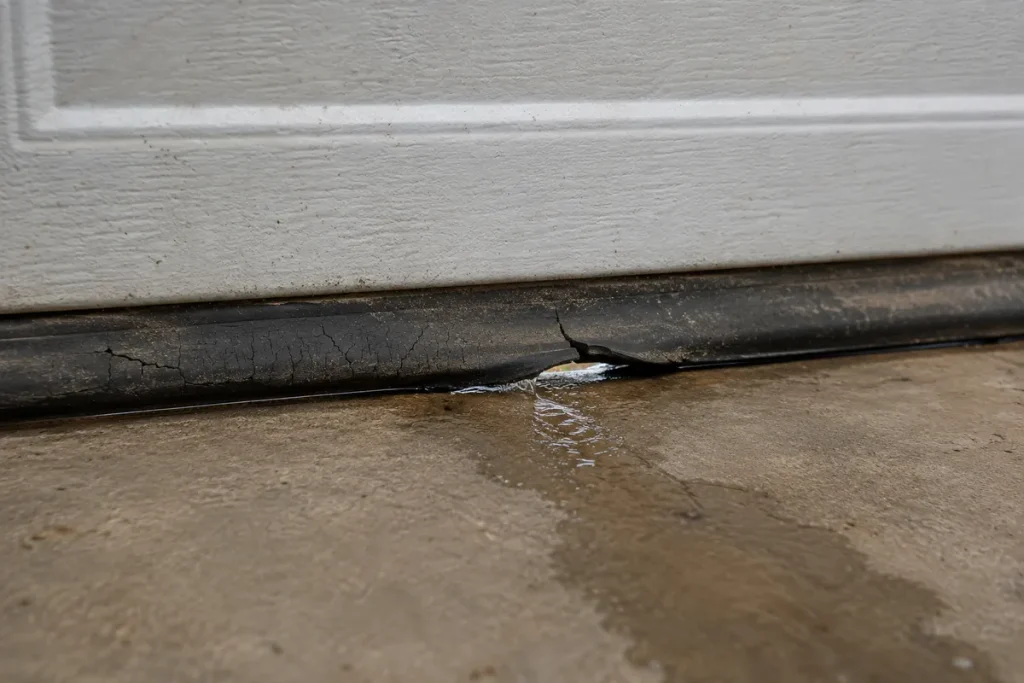
On a reverse-slope driveway with hydrostatic pressure behind the water, that calculation changes. Water driven toward the door finds the path of least resistance — any point where the seal doesn’t make full contact with the floor. A floor that has settled, cracked along a control joint, or heaved from frost leaves a gap a rigid vinyl seal can’t bridge.
Builder-grade vinyl seals are designed for standard conditions. They’re not built for the combination of hydrostatic pressure, an uneven floor, and the volume of water a North York reverse-slope driveway sends at the door in heavy rain.
Seal Types: What to Choose for a Reverse-Slope or Uneven Floor
Not all bottom seals are built for the same conditions. The three common profiles are T-style, J-type, and bulb seals — and the right one depends on how uneven the floor is.
T-style seals are the most common type. A T-shaped rubber or vinyl strip slots into a retainer along the bottom of the door panel; both legs of the T compress against the floor when the door closes. They work reliably on flat, level floors and are what most builder installs use. On an uneven floor, the rigid profile leaves gaps wherever the concrete dips.
J-type seals use an asymmetric profile with a longer contact leg that bends at an angle against the floor. The angled contact gives more flex than a T-style, making J-type seals better suited to floors with minor irregularities. They’re a step up from the builder default without requiring a full threshold system.
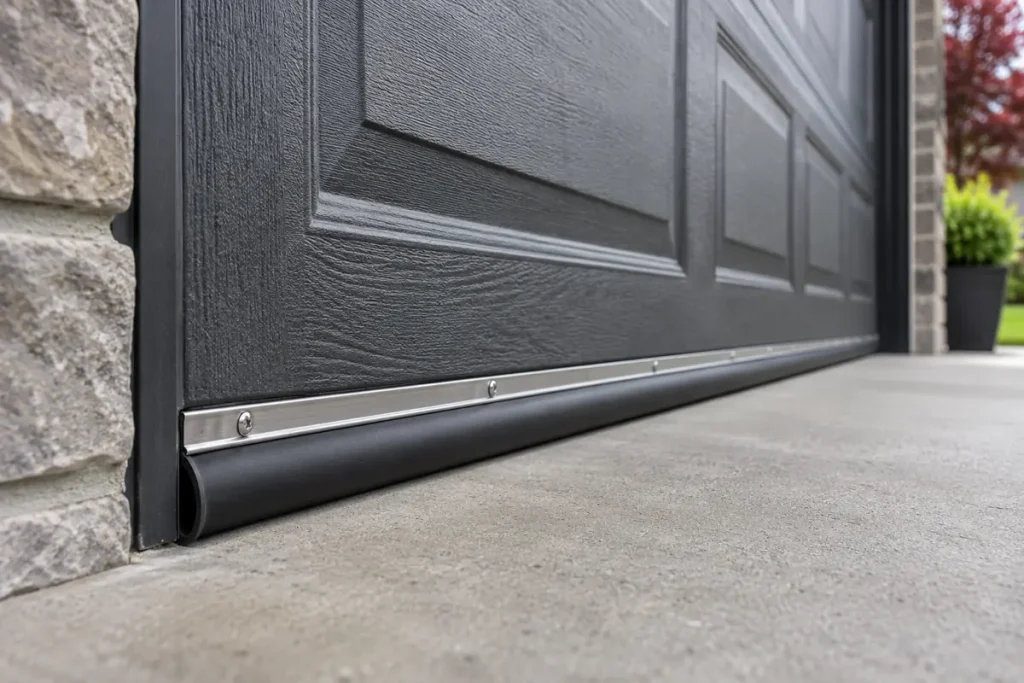
Bulb seals have a rounded, hollow rubber profile that compresses and spreads on contact with the floor. Because the bulb can deform and flatten, it maintains contact across a wider range of surface variation than either T-style or J-type seals. For a North York reverse-slope application with a floor that’s settled unevenly or heaved from frost, a heavy-duty rubber bulb seal is the most reliable choice.
When the floor irregularity is significant or the driveway grade is severe, a floor-mounted threshold bar adds a second line of protection. A threshold bar is a strip of rubber or aluminium mounted to the garage floor across the full width of the opening. The door closes onto the threshold rather than the floor, creating a tighter seal at a consistent height regardless of what the concrete behind it is doing. A bulb seal paired with a threshold bar handles the conditions that defeat a standard T-style vinyl seal on its own.
Perimeter weatherstripping on the sides and top should also be checked when addressing a water problem. Water can enter at the sides if the perimeter seal has worn or the frame has shifted. For door replacement costs if the door itself needs upgrading, see how much a new garage door costs in Ontario.
Frequently Asked Questions
Why does water keep getting under my garage door even after replacing the seal?
If the new seal isn’t holding, the floor below the door is likely uneven, or the driveway grade is directing more water at the door than a standard seal can handle alone. A heavy-duty rubber seal paired with a threshold bar is the solution for floors with dips or cracks. If water volume is high, also check that the driveway drainage isn’t blocked.
Does a bottom seal also keep warm air in the garage?
Yes. A garage door bottom seal that closes the gap between the door and the floor stops warm air from escaping at the base of the door in winter and cold air from entering. For an attached garage in North York, that matters for the comfort of adjacent living spaces. An insulated garage door with a good bottom seal and perimeter weatherstripping provides a meaningfully tighter seal than an uninsulated door with a worn or standard vinyl seal.
How do I get a tight seal on an uneven garage floor?
A flexible rubber bottom seal conforms to floor irregularities better than a rigid vinyl seal. For significant unevenness, a threshold bar levels the contact surface across the full door width. If the floor has heaved or cracked severely, filling low spots with floor levelling compound before installing a new seal gives the seal a consistent surface to compress against.
How often should a garage door bottom seal be inspected?
Inspect the garage door bottom seal at least once a year — ideally in autumn before winter sets in and after spring snowmelt when water issues are most likely to show up. Look for visible gaps when the door is closed, cracks or stiffness in the rubber, and any area where water has tracked past the seal line. A seal that has stiffened or cracked in cold weather won’t recover — replace it rather than waiting for visible water damage.
Can a garage door bottom seal be replaced without replacing the door?
Yes. The bottom seal mounts in a retainer along the bottom edge of the lowest door panel and can be replaced independently of the door itself. The retainer is typically held by screws or crimped into the panel edge; the old seal slides or pulls out and the new one slots in. For doors with an unusual panel profile or a custom retainer, confirm the seal profile before ordering.
Get Garage Door Seal Help From Doormatic
Doormatic services and installs garage doors and bottom seals across North York, Toronto, Woodbridge, Vaughan, and the GTA.
For a quote or service call, call 416-722-6595, email info@doormatic.ca, or request a free estimate online. Based at 180 Trowers Rd, Unit 23, Woodbridge, ON L4L 8A6.