By Doormatic Technical Staff | Certified Garage Door Specialists, Woodbridge, ON
A parkade is a multi-level building designed specifically for vehicle parking — and a parkade door (or parking garage door) is the high-cycle entry system controlling vehicle access in and out. The term “parkade” is common in Canada, while “parking garage” is prevalent in the US. Both refer to a parking structure whose doors must handle constant traffic, harsh weather, and around-the-clock security. See our garage door in Woodbridge page for details.
Doormatic installs and services parking garage doors across Toronto and the GTA for condos, commercial buildings, and mixed-use facilities.
What Exactly Is a Parkade?
A parkade is a multi-level parking structure — serving condos, office towers, shopping malls, and transit hubs — designed to maximize vehicle capacity on a compact urban footprint.
Parkades are commonly located near high-demand areas like office towers and shopping malls, and often support public transit access near transit stations. In Toronto, parkades alleviate limited parking space — improving urban parking efficiency by reducing curbside demand and helping the city manage congestion.
Compared to surface parking lots, parkades provide significant weather protection, better security, and higher capacity per square metre. They suit long-term parking in dense urban areas, and many include electric vehicle charging and secure payment options.
What Is a Parking Garage Door and Why Does It Matter?
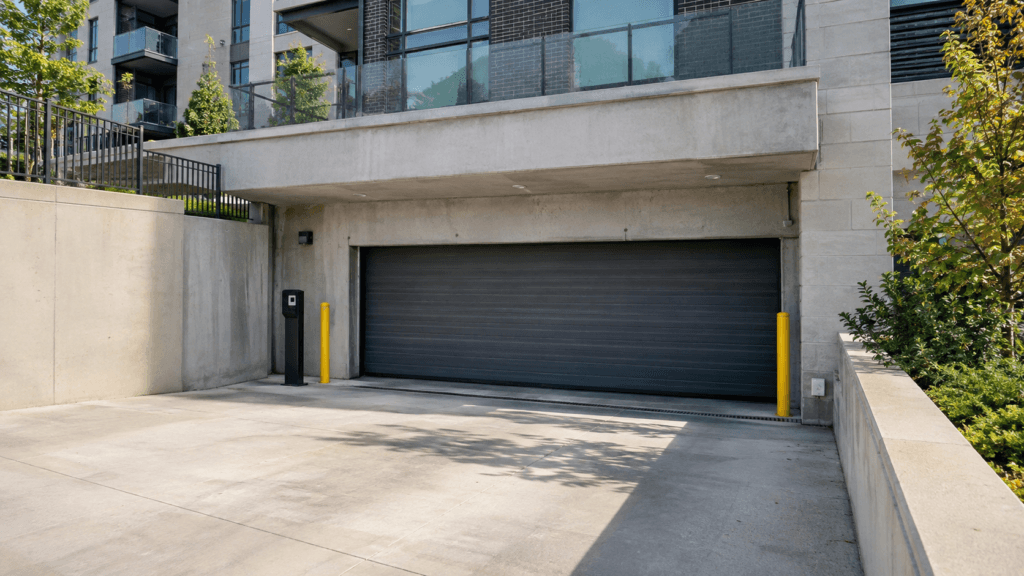
A parking garage door is the vehicle entry and exit barrier for a parkade or parking structure — engineered for high cycle counts, fast operation, and reliable performance in all weather.
Unlike a residential door cycling a few times daily, parking garage doors on a busy facility cycle hundreds of times per day. That demands high speed operation to maintain traffic flow, heavy-duty construction to withstand constant use, and access control integration restricting entry to authorized vehicles only.
The door is also central to the facility’s security envelope. A slow or unreliable door creates entrance queues, frustrates residents and employees, and leaves the building exposed when stuck open. For condos and commercial facilities, the parkade door is essential infrastructure.
What Types of Doors Are Used in Parking Applications?
The most common doors for parking applications are high-speed rubber doors, security rolling doors, security grilles, and heavy-duty sectional doors — each suited to different traffic volumes and security requirements.
High-speed rubber doors:
The performance benchmark for busy parkades. High-speed rubber parking garage doors can open at up to 55 inches per second — keeping traffic moving at peak hours. Flexible rubber construction resists impact damage from vehicle contact.
Security rolling doors:
Steel rolling doors deter unauthorized access in parking garages — the standard choice where security outranks speed. Suited to overnight closure and lower-traffic facilities.
Security grilles:
Open-pattern rolling grilles provide airflow and visibility while restricting access. Commercial-grade grilles withstand 20–40 psf static windload depending on specification — important for exposed Toronto entrances.
Heavy-duty sectional doors:
Insulated sectional doors suit smaller parkades where noise, aesthetics, and thermal control matter alongside function.
Parking garage gates:
Barrier arms restrict entry to authorized vehicles only — usually paired with a door, handling access control while the door handles security and weather.
The right choice depends on traffic volume, security requirements, headroom, and weather exposure. Doormatic assesses all four before recommending a solution for any parking structure.
How Do Access Control Systems Work With Parkade Doors?
Access control integrates the parkade door with the building’s entry management — keycards, fobs, transponders, or license plate recognition — so only authorized vehicles enter.
Keycard entry systems enhance security in parking facilities by logging every entry and exit. Condo residents typically use fobs or transponders; commercial facilities mix keycards, intercom-released entry, and time-limited codes for employees and visitors.
Posted signs and directional systems guide drivers through entry lanes, while door speed determines how quickly queues clear. A well-specified system balances security with traffic flow — locking the facility down without creating bottlenecks at the entrance and exits.
Doormatic integrates new parking garage doors with existing access control infrastructure — or installs both together on new construction and retrofits.
Why Is Door Speed So Important in Parking Garages?
Door speed directly determines traffic flow at the parkade entrance — high performance doors opening at 50+ inches per second prevent queues, reduce idling, and improve the daily experience for everyone using the facility.
A door taking 15 seconds to open, cycling 300 times daily, creates 75 minutes of cumulative wait time — vehicles idling, pedestrians navigating queued cars, frustration building for residents and employees.
High-performance doors enhance traffic flow and require minimal maintenance for reliable operation. Fast operation also improves security: less open-door time means a smaller window for a tailgating vehicle to follow an authorized one through.
Speed matters most at peak-surge facilities — condos at morning departure, office parkades at business hours, retail at weekends.
What Maintenance Do Parking Garage Doors Need?
Parking structures require regular maintenance for safety and longevity — and the door is the highest-wear component in the facility.
A parkade door cycling 200–300 times daily accumulates a year of residential wear in roughly two weeks. High-cycle operation stresses every component — springs, rollers, tracks, seals, and the operator — at a rate residential doors never approach. The maintenance schedule for a parking garage door should reflect that reality.
Maintenance covers:
- Spring and counterbalance inspection: High-cycle springs must be replaced proactively — not after failure closes the entrance. A failed spring on a parkade door does not just inconvenience one household; it shuts down vehicle access for the entire building or facility.
- Track, roller, and guide checks: Misalignment compounds quickly under heavy use. A slight track deviation that would go unnoticed on a residential door creates vibration, wear, and premature failure on a commercial door cycling hundreds of times daily.
- Safety system testing: Photo eyes, reversing edges, and pedestrian detection must function reliably where drivers and pedestrians share space. Safety system testing should be documented on every service visit.
- Motor and operator service: Commercial operators need scheduled inspection under continuous load. Motor brushes, drive systems, and control boards wear differently under commercial duty cycles than under residential use.
- Weather seal checks: Toronto’s freeze-thaw cycle degrades seals faster than moderate climates. Bottom seals that contact the floor are particularly vulnerable — a failed seal allows water, snow, and cold air into the structure, accelerating corrosion on vehicles and hardware.
- Lubrication: High-cycle doors require lubrication on a fixed schedule, not on complaint. Dry rollers and hinges under heavy use generate noise, friction, and heat that shortens component life.
A broken parkade door is a building-wide problem — residents cannot access vehicles, deliveries stall, and the facility is stuck open (a security failure) or closed (an access failure). Scheduled maintenance costs far less than emergency response and the operational disruption that accompanies it. Doormatic offers maintenance plans calibrated to your facility’s cycle count, not a generic residential schedule.
What Are the Key Differences Between Residential and Commercial Garage Doors?
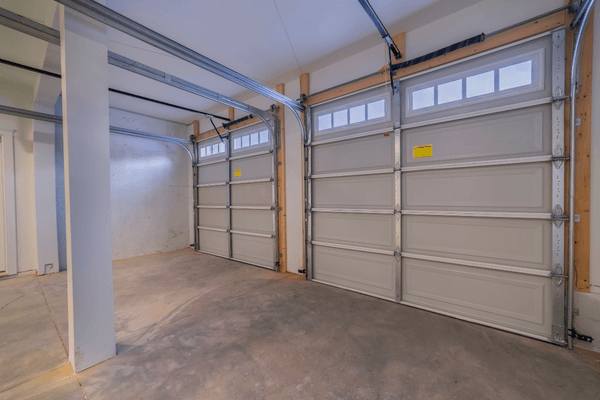
Commercial parking garage doors are engineered for a fundamentally different duty cycle, safety environment, and access control requirement than residential doors.
A standard residential garage door cycles 3–5 times daily and requires annual maintenance. A parking garage door in an active facility cycles 200–400 times daily and requires quarterly or semi-annual inspection at minimum. The components are not simply scaled up — they are engineered differently.
Commercial doors must meet higher safety standards where pedestrians and vehicles share space. Reversing mechanisms, bottom edges, and safety sensors must respond within fractions of a second to prevent injury — and they must do so reliably across tens of thousands of cycles before any service.
Access control integration adds another layer of complexity absent from residential applications. A residential door responds to a single remote or keypad. A parkade door integrates with building management systems, condo corporation entry logs, visitor management, and in some cases municipal parking enforcement systems.
Fire ratings, windload specifications, and building code compliance requirements also differ significantly. Toronto building code requirements for commercial parking facilities are more stringent than residential equivalents — and the door specification must reflect that.
What Should Toronto Property Managers Expect From a Parkade Door Project?
A parkade door project covers site assessment, specification, installation, access control integration, and a maintenance plan — typically with minimal disruption to parking operations.
For occupied condos and active commercial buildings, scheduling matters. Doormatic plans replacement around the facility’s low-traffic hours, maintains alternative access where the site allows, and completes most single-door installations within one working day.
Toronto’s climate shapes the specification: exposed entrances need windload-rated construction, freeze-thaw rated seals, and operators with thermal protection. Design and aesthetics matter too — the parkade door is often part of the building’s visible frontage, and a variety of finishes are available to match the architecture.
Condo properties have additional considerations. Condo corporations govern the common elements — the parkade door is typically a common element, meaning the board or management company controls the specification and procurement process. Work orders may require board approval, and scheduling must account for resident notification requirements. Doormatic works within condo procurement processes routinely and can provide the documentation boards require.
Commercial and mixed-use buildings may have service-level agreements requiring guaranteed response times for door failures. Doormatic’s maintenance plan options include priority response commitments — documented in writing before the plan begins, not verbal assurances.
New construction projects benefit from early consultation on door specification — headroom, rough opening dimensions, and electrical rough-in requirements all affect what door types are viable. A specification established after construction is complete limits options and can increase installed cost significantly.
Regardless of property type, Doormatic provides a written specification, a written quote, and a written maintenance schedule before any work is approved. The project scope does not change without written approval from the property manager or authorized representative.
Why Doormatic for Parking Garage Doors in Toronto
Doormatic installs and services parking garage doors for condos, commercial buildings, and parking operations across Toronto and the GTA — handling the complete project with the reliability essential building infrastructure demands.
Toronto’s commercial door market includes a wide range of operators — some specializing in residential work and adapting to commercial, others primarily serving industrial applications. Parkade doors sit in a specific category: high-cycle, access-controlled, weatherproofed, and integrated with building systems. Doormatic’s team works in this category routinely across the GTA.
- High speed and high performance door solutions for every parking structure
- Access control integration: fobs, keycards, transponders, and license plate recognition
- Scheduled maintenance plans calibrated to your facility’s actual cycle count
- Emergency service — because a stuck parkade door can’t wait until Monday morning
- Insured, experienced technicians on every project — no subcontracting
- Written specification, written quote, and written maintenance schedule before approval
- Free site assessment for any facility across Toronto and the GTA
For commercial garage door installation and service in Toronto and the GTA, Doormatic provides free site assessments and written quotes before any work begins.
Frequently Asked Questions
What is a parkade and how is it different from a parking lot?
A parkade is a multi-level building designed specifically for vehicle parking, while parking lots are single-level surface spaces. Parkades maximize capacity on compact urban land, provide weather protection, and support enhanced security measures like surveillance and controlled access. The term is standard across Canada — in Toronto, parkades are common at condos, office towers, and transit stations.
What doors are best for parking garages with heavy traffic?
High speed rubber doors are the best choice for parking garages with heavy traffic — opening at up to 55 inches per second to keep vehicles moving at peak hours. They resist impact damage and reduce entrance queuing. Doormatic assesses your facility’s traffic volume and recommends the right specification for your parking applications.
How do high performance doors improve parking operations?
High performance doors enhance traffic flow, reduce queues, improve security by minimizing open-door time, and require less maintenance under high-cycle use. For busy parkades cycling hundreds of times daily, the performance difference is measurable in wait times, energy costs, and service call frequency.
How often do parking garage doors need maintenance?
Parking garage doors in high-traffic facilities should be serviced at least twice a year — more frequently for doors cycling 200+ times daily. Maintenance covers springs, tracks, safety systems, and the operator. A parkade door accumulates residential-equivalent annual wear in weeks, so proactive service prevents the failures that shut down facility access entirely.
Does Doormatic install parkade doors for condos in Toronto?
Yes. Doormatic installs and services parkade doors for condos, commercial buildings, and mixed-use facilities across Toronto and the GTA — handling assessment, installation, access control integration, and maintenance. Installation is planned around low-traffic hours to minimize resident disruption. Contact us for a free site assessment.
Conclusion
A parkade door is essential infrastructure — controlling access, maintaining security, and keeping traffic flowing for every resident, employee, and visitor. The right specification depends on traffic volume, security needs, exposure, and access control integration. Getting it wrong means emergency calls, building-wide access failures, and repair costs that dwarf the cost of a correctly specified door from the start.
For property managers and condo boards in Toronto and the GTA, the key steps are: assess the facility’s actual cycle count and security requirements; specify a door rated for that duty; integrate with the building’s access control system from day one; and put a maintenance plan in place before the door is commissioned, not after the first failure.
Our team is available for a free site assessment across Toronto and the Greater Toronto Area — for any parking structure from a single-entrance condo to a multi-door commercial facility.
Contact Doormatic for a free site assessment — reliable installation and service, year round across Toronto and the GTA.
About Doormatic
Doormatic is a Woodbridge-based commercial door company providing parking garage door installation, service, and access control integration for condos, commercial buildings, and mixed-use facilities across the Greater Toronto Area.
Service Area
Doormatic serves Woodbridge, Vaughan, North York, Toronto, Mississauga, Brampton, Richmond Hill, Aurora, and King City. NAP: 180 Trowers Rd Unit 23, Woodbridge, ON L4L 8A6 · 416-722-6595 · info@doormatic.ca.
Next Step
Request a free site assessment or written quote. Commercial garage door installation — Toronto and the Greater Toronto Area.